Operational Interoperability
for AI-Supported Product Systems
"Design systems increasingly stabilize the shared operational structures through which humans, organizations, runtime systems and AI systems participate in product logic."
Shared Operational Structures
How human-relevant states become understandable, interoperable and governable across humans, runtime systems and AI-supported product systems.
Operational interoperability emerges when humans, organizations, runtime systems and AI systems participate through the same shared operational semantics. Integrity Architecture describes how those shared operational structures are stabilized across semantic, technical, organizational and AI-supported product systems. AI is therefore not treated as an isolated technology layer. It increasingly participates in the same operational structures already shared by humans, runtime systems and organizations. As AI participation grows, those structures increasingly need to remain human-readable, runtime-executable, machine-readable, agent-operable and governable.
I design shared product structures that enable distributed teams, enterprise platforms and AI-supported development to evolve without losing product coherence.
Fragmentation Zones
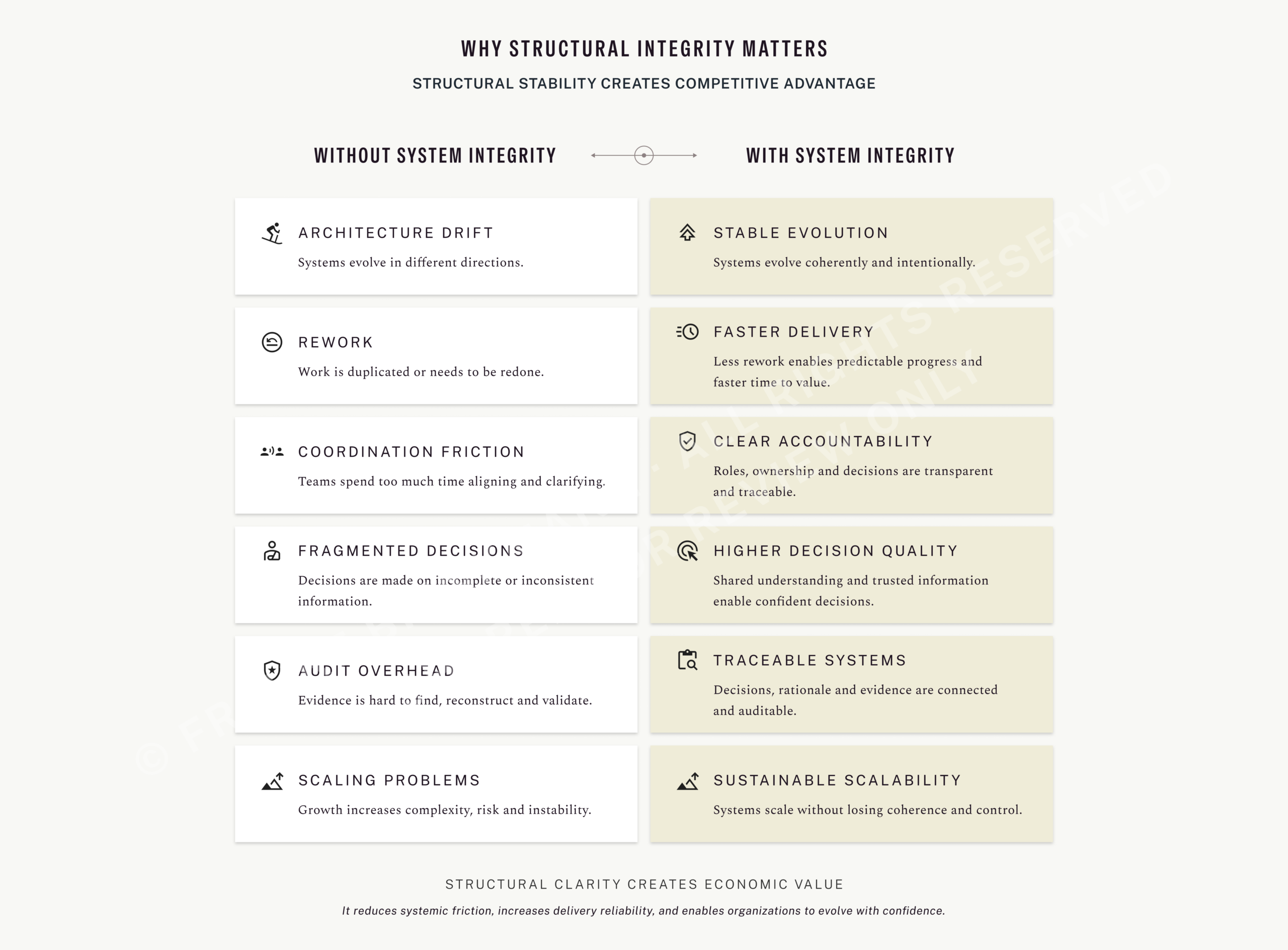
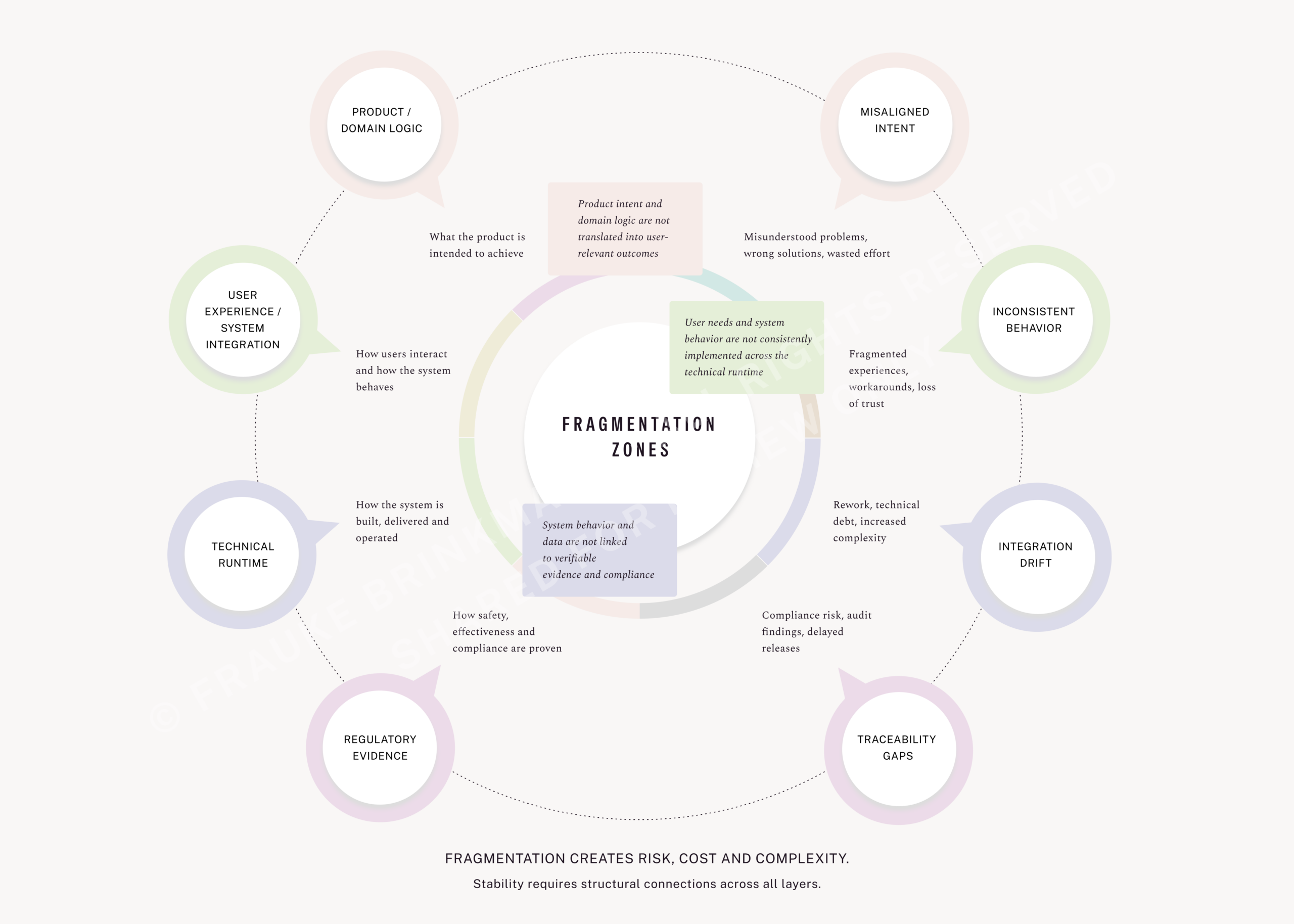
As product systems grow across domains, teams, technologies and regulatory contexts, fragmentation ceases to be an isolated inconvenience and becomes a systemic source of product, governance and compliance risk.
Digital product systems rarely break because of individual components. Structural risk emerges when the relationships between product intent, human use, technical implementation and regulatory evidence are not coherently connected.
As these relationships fragment, product systems increasingly drift across teams, runtime implementations and governance structures.
Cost of Misalignment
→ Fragmentation creates risk, cost and complexity.
→ Systems drift across runtime, governance and organizational boundaries.
→ AI amplifies architectural inconsistency without shared operational structures.
→ Product systems fail when operational relationships fragment.
“Product systems fail where critical relationships remain unstabilized.”
System Integrity in Practice
As product systems become increasingly distributed across domains, organizations, runtime environments and AI-supported workflows, the critical architectural challenge is no longer component consistency but operational coherence. System integrity emerges from explicit shared structures that preserve one operational logic across requirements, semantic contracts, runtime behavior, feedback loops and human decision making, enabling complex product systems to remain governable, interoperable and scalable while reducing structural product and governance risk.
01. Design Systems as Infrastructure
02. Shared Operational Logic
03. Semantic Contracts
04. Cross-Domain Behavioral Integrity
05. AI Governance Architecture
06. Decision Integrity
Who This Is For
Relevant for organizations operating in complex product environments where product intent, human use, technical implementation and regulatory requirements must remain structurally aligned.
· Executive Management
· Product Leaders
· Engineering Leaders
· Design Leaders
· Quality & Regulatory Teams
Integrity Architecture
How system integrity emerges through interoperable artifacts.
Design Systems as Infrastructure
Why design systems are enterprise infrastructure.
Publications
Articles on product systems, use cases and system architecture.
As AI accelerates product exploration, structural integrity becomes the critical design challenge.