
Frauke Brinkmann
Strategic UX Lead & Product System Architect for regulated multi-domain SaaS systems
Designing the Structural Integrity of Regulated Multi-Domain SaaS
THE SHIFT TOWARD
OPERATIONAL INTEROPERABILITY
As humans, organizations, runtime systems and AI systems increasingly participate in the same product logic, competitive advantage shifts toward the structures that enable coherent participation.
Integrity Architecture synthesizes 15+ years of experience in product design, usability engineering, design systems, and regulatory product development into an applied model for stabilizing complex product systems.
The perspective explains how the states that matter to humans are translated into scalable, traceable, and governable system structures through artifacts and governance.
Its contribution lies not in the individual concepts, but in their systematic integration into an operational model for regulated multi-domain SaaS product systems.
FOCUS AREAS
As product systems grow across domains, technologies, organizations and AI-supported workflows, structural risk increasingly emerges at the interfaces between them. This work focuses on the operational structures that keep those interfaces stable, understandable and governable.
Operational Concepts
→ Design Systems as Infrastructure
→ Integrity Architecture
→ Semantic Contracts & State Architecture
→ AI Governance Architecture
→ Usability Engineering & Regulatory Integration
→ Cross-Domain Behavioral Integrity
Operational Challenges
→ Make structural risk visible
→ Define the states that matter
→ Stabilize critical interfaces
→ Establish shared operational semantics
→ Translate architecture into scalable execution
Core Perspective:
Complex product systems rarely fail because of individual components or decisions. They fail when critical relationships between meaning, semantics, behavior, implementation and governance become fragmented. Integrity Integrity Architecture stabilizes these relationships and enables trustworthy decision systems through structural coherence.
Modern product systems increasingly operate through shared operational structures consumed simultaneously by humans, organizations, runtime systems and AI systems.
My work focuses on stabilizing these structures across semantic, technical, behavioral and regulatory dimensions.
Credentials
→ Strategic Product Design Leadership for Regulated Multi-Domain SaaS
→ 15+ Years in UX Architecture, Information Architecture & Product-System Design
→ Specialized in Regulated SaaS and SaMD
→ Certified Usability Engineer (IEC 62366-1, ISO 9241-210)
→ Lecturer at IU International University
→ Enterprise Design Systems, AI Governance & Product-System Architecture
Publications
My work explores how human-relevant states can be identified, formalized and structurally stabilized to create coherent product systems, trustworthy AI and sustainable economic impact.
The Architecture of Distributed Product Knowledge
How authoritative product knowledge can be projected into distributed agent contexts without turning local execution into local product truth.
When the Application Stops Being the Product
How product coherence shifts from application-contained logic to One Product Reality across distributed humans, applications, services, devices and AI agents.
The Interface Is Only the Face
How fundamentally different participants project and transform the same operational reality through Human Relevant States.
The Shared Operational Logic of AI-Era Product Systems
How shared semantics become interoperable across humans, organizations, runtime systems and AI.
I Need AI for My AI
Why trustworthy AI depends on preserving human judgment, situation awareness and decision quality.
Use Cases as Semantic Contracts
How human-relevant states become shared operational semantics.
The Dots That Matter
How human-relevant states become explicit structural reference points within product systems.
The Human Anchor of Product Systems
Why certain states become relevant because they shape what people understand, decide and do.
Reflexive Stability
How interconnected product systems remain operable as states and interpretations continuously evolve.
CURRENT RESEARCH DIRECTIONS:
Probability Generates Possibilities (soon)
Why probabilistic AI systems require semantic structures to transform interpretations into decision-capable states.
Decision Integrity Architecture (soon)
How human-relevant states become actionable situation awareness, trustworthy judgment and responsible decisions.
Beyond Context Engineering - The Architecture of Trustworthy Decision Systems (soon)
How trustworthy decision systems emerge from shared operational semantics, governance and human-centered product architecture.
Organizational Adaptability (soon)
How organizations continuously evolve by stabilizing shared operational structures instead of isolated processes.
From Human Relevant States to Trustworthy Decision Systems
Products are shared operational realities
Human-relevant states are the structural foundation of trustworthy decision systems. AI reveals the operational structures that organizations have always depended on.
As AI increasingly participates in product systems, the challenge shifts from generating outputs to preserving human judgment, decision integrity and accountable action.
The question is no longer how systems generate information. The question is how information becomes understandable, challengeable and responsibly actionable.
“I design decision architectures that transform AI-generated complexity into trustworthy attention and actionable situational awareness.”
Decision architecture and situational awareness reduce cognitive overload, improve decision quality and enable trustworthy human oversight in AI-supported product systems.
From Human-Relevant States to Trustworthy Decision Systems
Trustworthy decision systems emerge when human-relevant states progressively become shared meaning, stable semantics, executable behavior, accountable governance and decision integrity. The resulting operational architecture enables coherent participation across humans, organizations, runtime systems and AI.
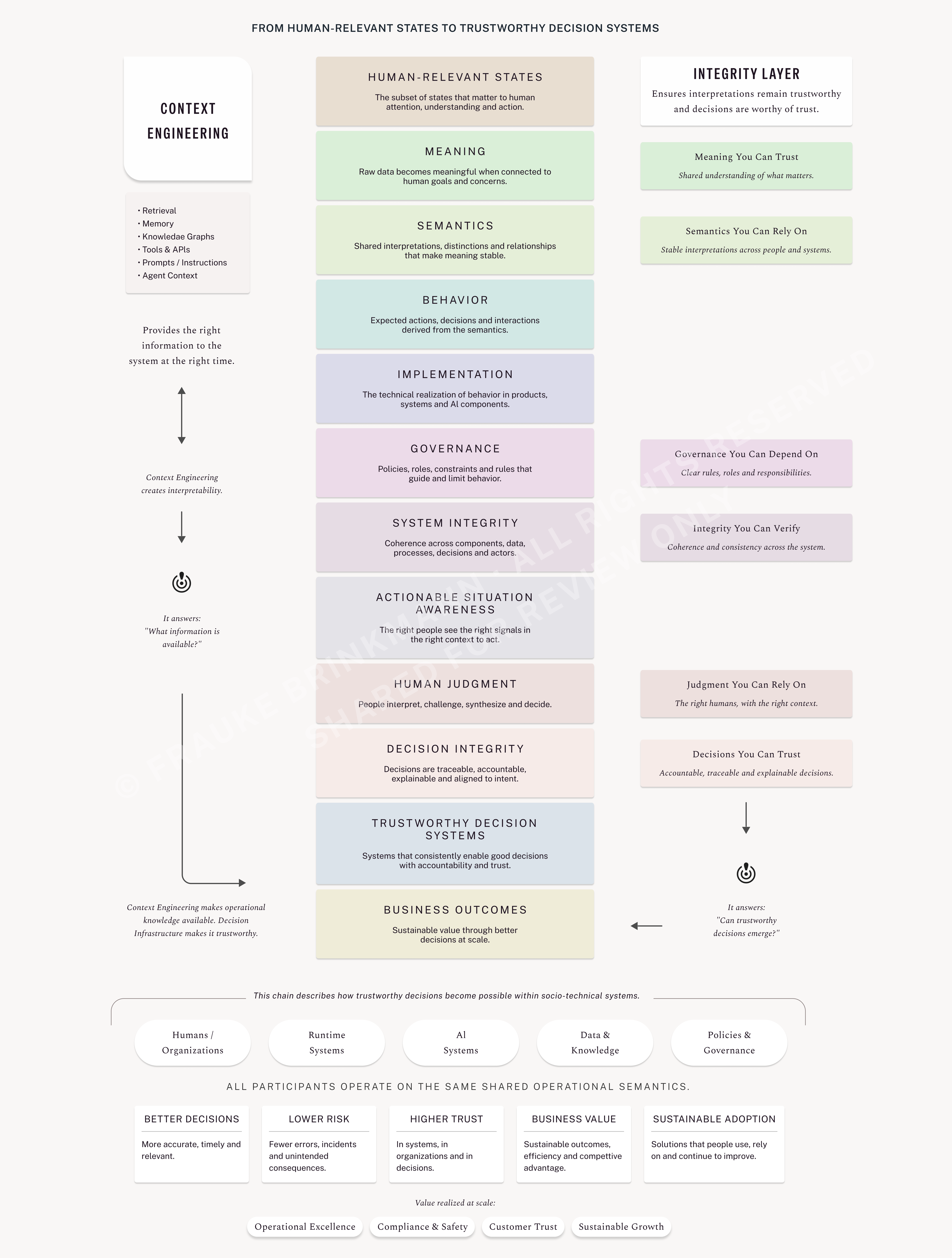
Operational Adaptability
The competitive advantage of modern product systems no longer lies only in efficiency or automation. It lies in the ability to continuously evolve shared operational structures while preserving decision integrity.
Selected Areas of Expertise
→ Regulated Product Development
→ Decision Architecture & Situational Awareness
→ Enterprise Design Systems
→ UX & Product System Architecture
→ Semantic System Design
→ AI-Supported Product Development
→ Governance and Change Control
→ Accessibility and Usability Engineering
→ Product System Strategy
UX is the integration layer between human use, system architecture and regulatory evidence.
Case Studies
This website serves as a public portfolio of conceptual models, publications and ongoing research on structural integrity in complex product systems.
Part of my work in enterprise product development is designing shared operational structures that preserve product coherence and reduce structural product and governance risk by stabilizing the relationships between product intent, human use, technical implementation and regulatory evidence.
Integrity Architecture for Product Systems is my architectural perspective on operational interoperability, shared semantics and trustworthy decision systems in complex product environments.
Selected executive case studies are available in confidential conversations.
3. 1. From AI Exploration to Governed Product Development
AI Governance Architecture
3. 2. From Fragmented Implementation to Shared Product Infrastructure
Versioned Frontend Platform & Production-Ready Prototyping
3. 3. From Tool-Specific Prototypes to System-Compatible Exploration
PM-to-Dev Bridge
3. 4. From Runtime-Defined Logic to Explicit Semantic Contracts
Semantic Contract Architecture
3. 5. From Domain Fragmentation to Cross-Product Coherence
TwistLock — Cross-Domain Behavioral Architecture
3. 6. From Retrospective Evidence to Embedded Traceability
Regulatory Operating Model
Frauke Brinkmann
Strategic UX Lead & Product System Architect | Regulated Multi-Domain SaaS (SaMD) | Enterprise Design Systems | AI Governance | Usability Engineering (IEC 62366-1) | Lecturer IU
Prediction
The next competitive advantage will not come from generating more intelligence. It will come from preserving shared understanding, responsible judgment and organizational adaptability as AI becomes part of everyday product operations. Organizations will increasingly compete through their ability to continuously learn, adapt and stabilize shared operational structures across humans, runtime systems and AI systems. The next generation of enterprise architecture will optimize organizational adaptability rather than organizational efficiency.