Integrity Architecture
How system integrity emerges through interoperable artifacts.
In complex product systems, structural risk does not primarily arise within individual disciplines. It emerges where relationships between product intent, human use, technical implementation and regulatory evidence are not sufficiently stabilized.
Integrity Architecture explains how interoperable artifacts transform these relationships into coherent, scalable and auditable system structures, enabling shared operational structures that remain understandable, governable and interoperable across human, technical and organizational participation.
"As AI increasingly participates in operational product systems, architecture expands beyond technical implementation toward the operational integrity of the product system itself."
AI does not introduce a separate operational layer. It increasingly participates in the same operational structures already used by humans, organizations and runtime systems. As a result, product systems increasingly depend on shared operational structures that remain understandable, governable and interoperable across human and machine participation.
Structural Problem Landscape
Complex product systems evolve across multiple interdependent layers. Fragmentation at critical interfaces leads to misaligned intent, inconsistent behavior, integration drift and evidence gaps.
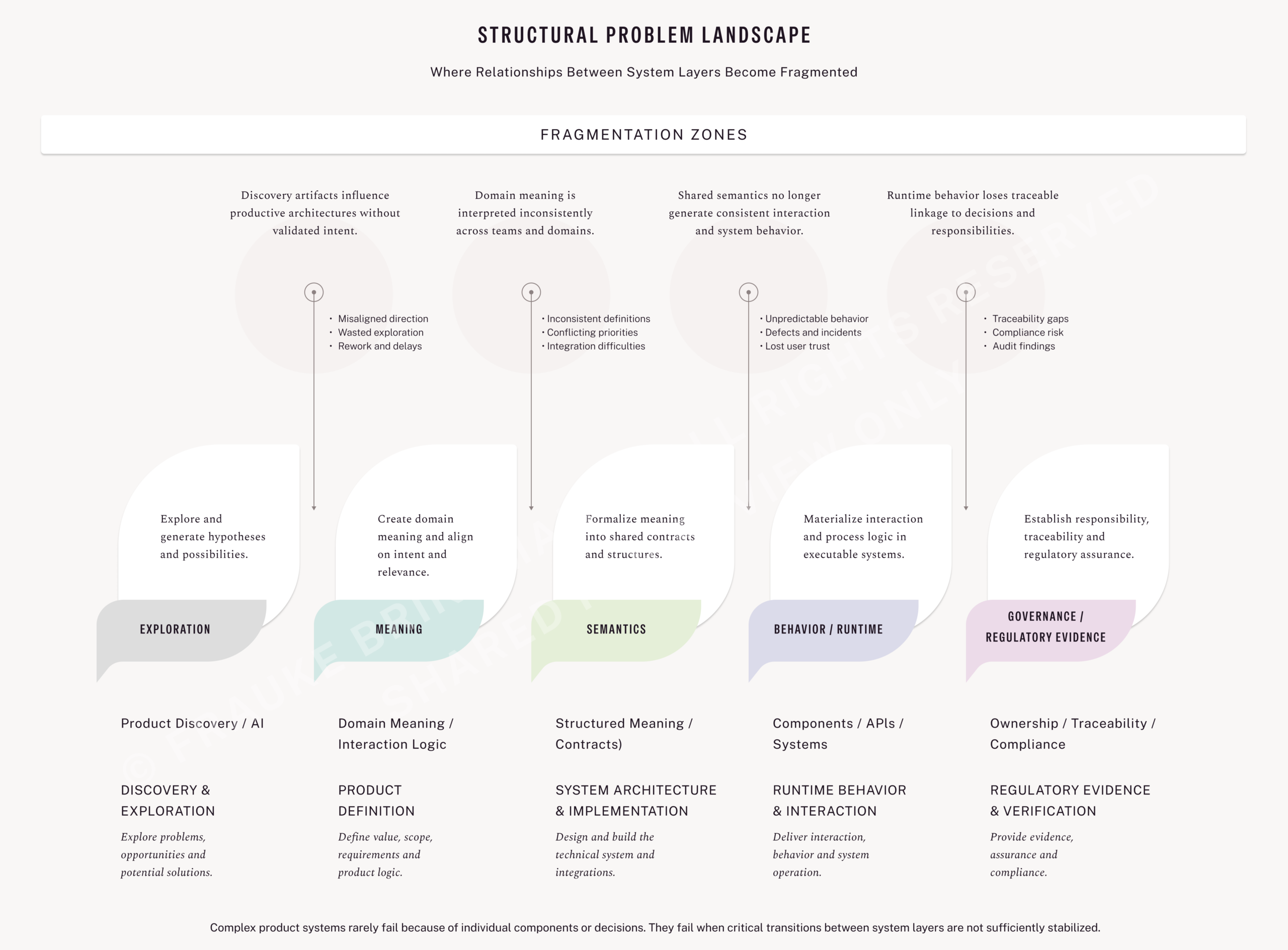
“System integrity is an emergent property of stabilized relationships.”
System Integrity Evolution Model
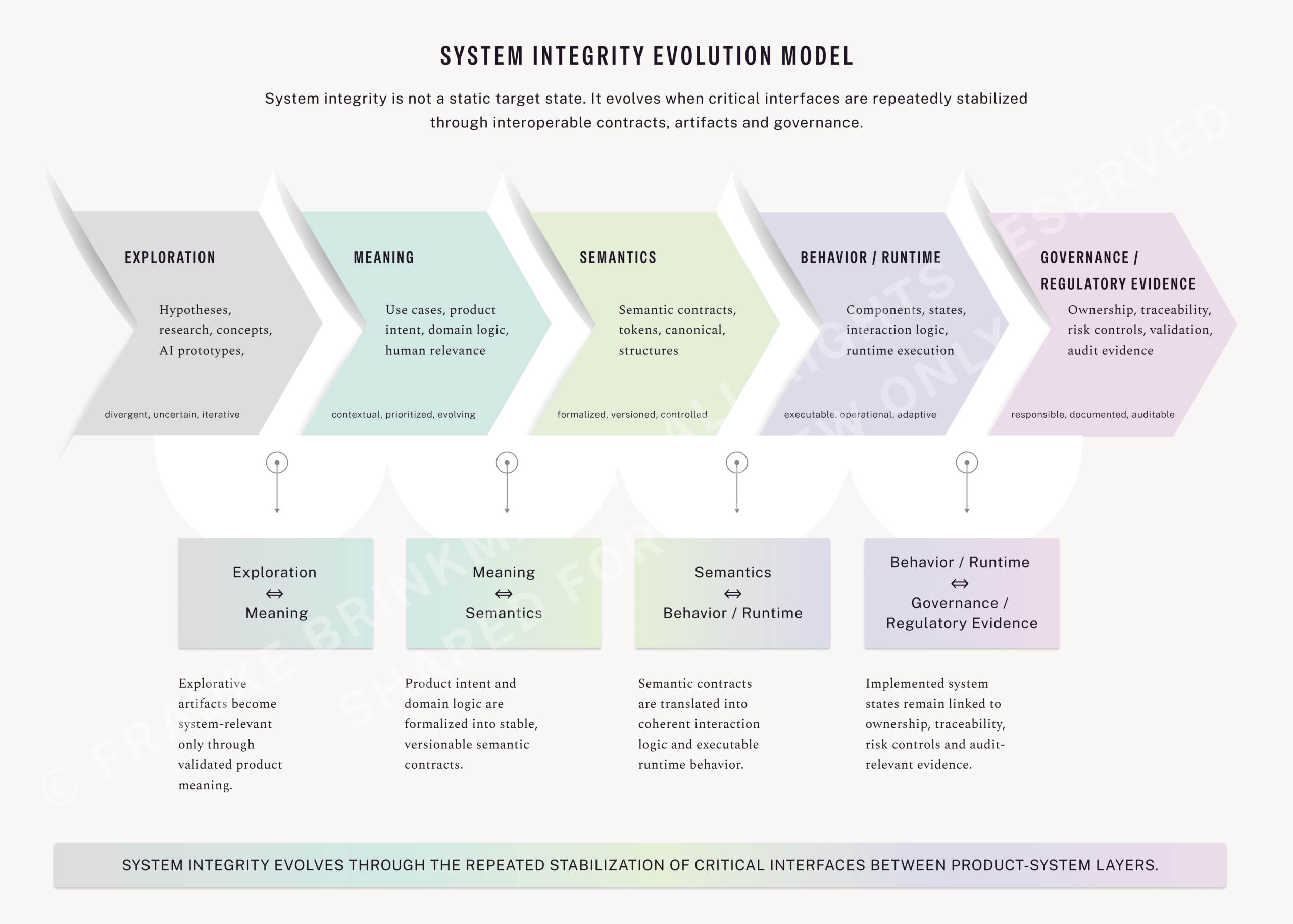
System integrity does not emerge at a single point in time. It evolves as critical interfaces between product-system layers are repeatedly stabilized through interoperable contracts, artifacts and governance structures.
From States to System Integrity
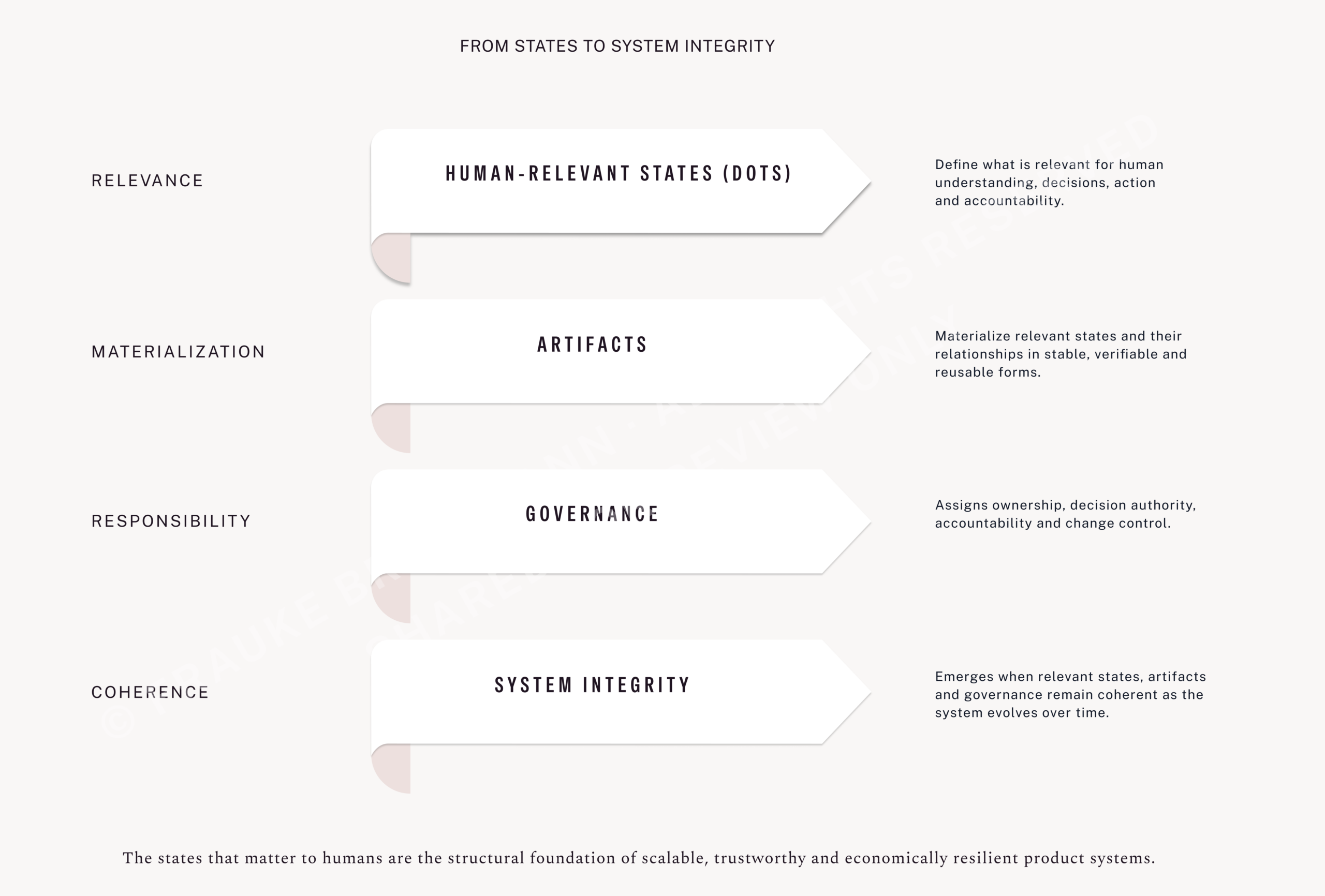
A coherent product system can be understood through four conceptual layers.
→ States define what matters.
→ Artifacts stabilize what matters.
→ Governance assigns responsibility.
→ System integrity emerges.
System Integrity Framework
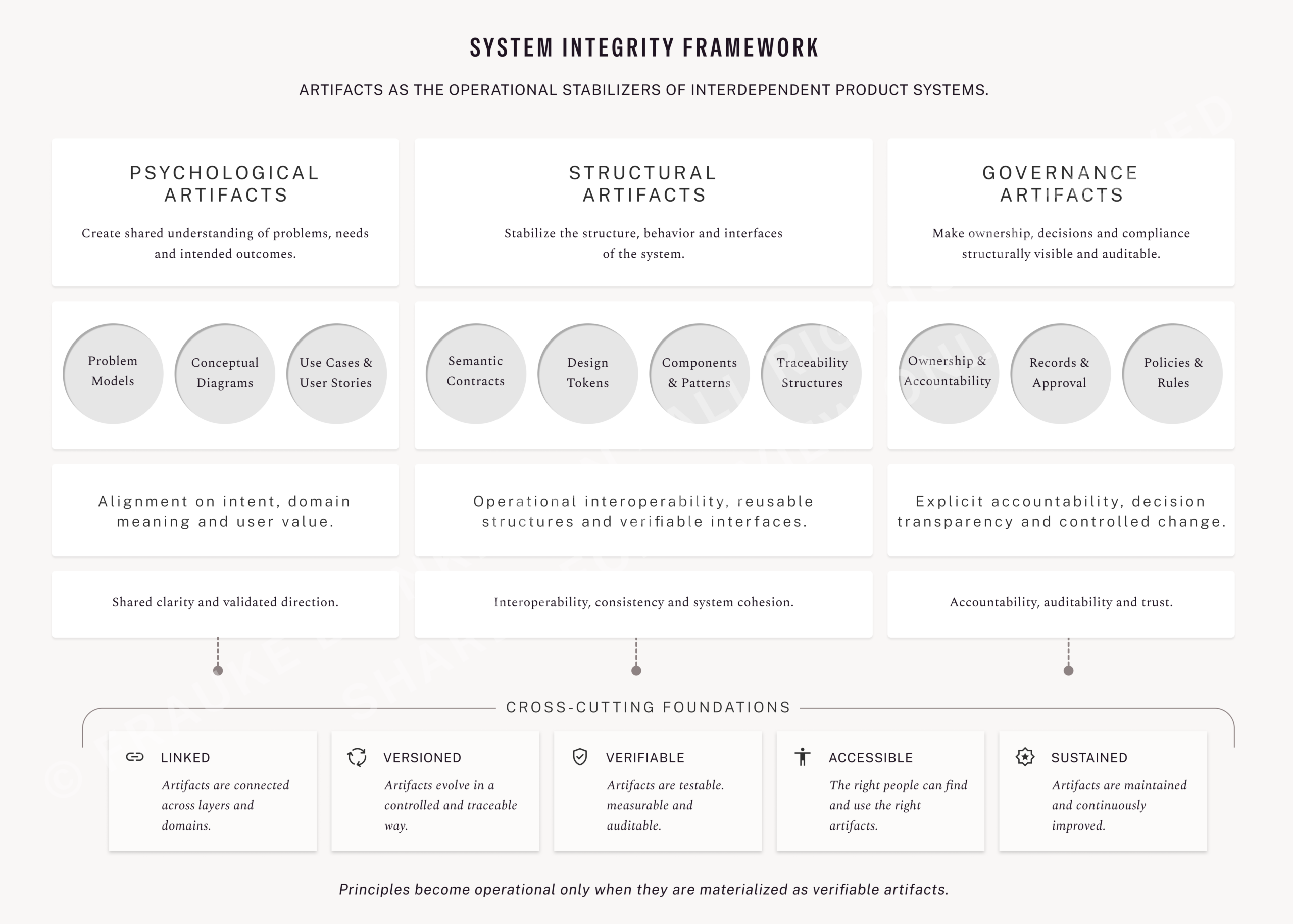
Structural clarity becomes organizational value only when decisions are materialized as verifiable artifacts. The System Integrity Framework defines the artifact classes that reduce structural risk, enable scalable execution and make accountability auditable.
System Integrity Framework
Artifacts as the operational stabilizers of interdependent product systems.
Principles and intentions remain interpretive until they are materialized as verifiable artifacts. The System Integrity Framework distinguishes three artifact classes that stabilize shared understanding, structural interoperability and organizational accountability.
"The same operational artifacts increasingly coordinate human decisions, runtime systems, organizational governance and AI-supported workflows simultaneously."
Economic Impact
Structural clarity creates measurable business value by reducing systemic friction and increasing delivery reliability.
· Reduced structural risk
· Higher decision quality
· Improved auditability
· Sustainable scalability
“Integrity architecture transforms structural clarity into organizational and economic advantage.”
Architecture Paper
An operating model for understanding how system integrity emerges through artifacts, governance and interoperable product-system structures.
1 . 1. Product Systems as Socio-Technical Systems
1 . 2. Structural Fragmentation in Complex SaaS Systems
2 . 0. Operating Model for System Integrity
2 . 1. System Integrity Evolution Model
2 . 2. From Principles to Artifacts
2 . 3. System Integrity Framework
2 . 4. Economic Impact of Structural Integrity
2 . 5. Institutionalizing Integrity Architecture
2 . 6. Methodological Integrability of Integrity Architecture
Available upon request for qualified conversations.